












Affiliate marketing, to some degree, is akin to a shopping district with countless users scrolling past your offer. Although most of them usually see your creatives, only a handful of them stop to make a purchase or complete any other target action.
The location plays a very important role in such shopping districts. You don’t want to get lost in the crowd of sellers; you want to stand out by positioning yourself closer to the entrances, so you can reach users when their purchasing intent is high.
Now, what if you could secure the same level of intent-driven visibility within the affiliate ecosystem?
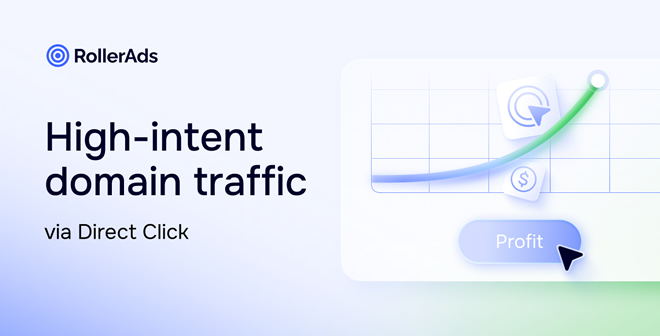
Introducing Direct Click. This performance-focused ad format has quickly become a go-to for savvy media buyers and affiliate marketers. Direct Click connects advertisers with users who are already in an active browsing mindset: delivering solid traffic, stronger engagement, and more efficient campaign optimization.
In this article, we'll walk through:
The mechanics behind Direct Click traffic
Key advantages for performance-driven advertisers
Top-converting verticals and use cases
Prefer to watch? You can check out our video on the RollerAds YouTube channel.
Explaining Direct Click traffic
The Direct Click format aggregates several traffic sources. Here, however, we’ll focus on its highest-volume component, namely domain redirect traffic.
So, whenever a user lands on parked, expired, or typo domain, instead of ending up on an empty page, they get instantly redirected to the relevant advertiser's offer.
What makes this channel valuable is that the user has a clear goal from the start. That already existing intent creates a stronger signal than what standard display ads have. This signal translates into higher engagement rates and more efficient funnel progression.
How domain redirect within Direct Click works
The system works in three clear steps:
A user appears on a parked, expired, or mistyped domain.
Instead of an error or empty page, the user is automatically sent to the advertiser's offer.
The advertiser pays only when the user arrives on the landing.
Because the user started with a specific goal in mind, this traffic behaves more like search traffic. That makes Direct Click a reliable option for performance marketers who want engaged users and measurable results.
Vertical recommendations: What works best
Direct Click traffic can support a wide range of offers. However, certain verticals tend to perform better because of their intent-driven nature.
Also, the results may vary based on these factors:
Target GEO
Device type
Landing page optimization
For this reason, testing multiple offers and setups is a necessary step to find what works best for your campaign.
Software & Utilities
Software offers are among the most popular campaigns on Direct Click traffic. They work well because demand is broad and the user journey is short and simple, which is a good fit for redirect-based formats. Common software offer types include:
VPN services. VPN offers are driven by steady demand for privacy and access to region-locked content, which makes them perform strongly on domain traffic. Top GEOs include: the United States, Canada, the United Kingdom, Germany, France, Australia, and Brazil.
Browser extensions. Extensions that enhance browsing experience, like coupon finders, productivity tools, or security add-ons, also work well with domain traffic. We advise you to always check that the extension you promote supports the browser where your ad will appear. Desktop-heavy markets are the top GEOs for this offer, such as the United States, the United Kingdom, Germany, the Netherlands, and Scandinavia.
System utilities. Utilities like device cleaners, driver updaters, file managers, or optimization software are another reliable category. System utilities work in every GEO: the United States, the United Kingdom, Canada, Australia, India, Southeast Asia, South Africa, and others.
These products are handy for tackling everyday problems, an advantage that matches the intent-driven nature of Direct Click traffic perfectly: users land on the page and instantly see a relevant solution, which is a win-win in our books.
Search Feed campaigns
Another effective way to use Direct Click traffic is through Search Feed monetization. Here, users land on a search results page that runs on a search advertising feed. As they browse through the results, revenue is generated from clicks on paid listings and sponsored content.
Search Feed campaigns fit domain traffic like a glove. People who type in a domain name are usually looking for something specific. Give them a search-like interface, so that they find what they want on their own. This, in turn, leads to better engagement and higher earnings.
Ecommerce
Direct Click traffic also works well for eCommerce marketing campaigns. The main rule here is that your landing page should clearly display the product you're offering.
Good examples include:
Product discovery pages
Discount or deal pages
Marketplace landing pages
Single-product funnels
These campaigns tend to perform best in countries with high buyer spending power, such as the United States, the United Kingdom, Canada, Australia, and Western Europe.
Many users who arrive via domain traffic already have a goal in mind. That means they're often ready to explore relevant products or deals as soon as they land on your page.
Targeting with IAB categories
Direct Click traffic also lets advertisers target domains using IAB (Interactive Advertising Bureau) content categories. Every time a new domain is added, we analyze and assign it a category based on the IAB system. This is a widely used standard for sorting website content into clear categories.
Common IAB categories include: Technology, Business and Finance, Shopping, Health and Fitness, Travel, Entertainment, and more.
Using these categories, advertisers can match their campaigns with domains that fit their offer's theme.
For example:
A VPN campaign might target the Technology or Internet services categories.
An eCommerce offer could focus on Shopping or Consumer goods.
A financial search feed might target Business and Finance.
Such a contextual approach helps advertisers serve more relevant ads and optimize campaign performance, especially when scaling Direct Click campaigns across large sets of domain inventory. And keep in mind that the top-performing categories aren't always the most obvious ones, so regular testing is essential.
Final thoughts
Instead of focusing on raw numbers, it’s best to prioritize user intent. Direct Click is the ad format that connects you with users who are already motivated to take action. Whether you're promoting Software, eCommerce offers, or Search Feed, this high-intent domain traffic helps drive conversions faster.
You can test all the angles and approaches you want, while Direct Click handles the rest. Thanks to this format, you can capture high-intent users with a timely ad that perfectly matches their tastes. Try it out, and if there are any difficulties, we’re ready to help.


.png)














.png)