
















Digital campaigns rarely succeed through a single interaction. Users typically move through several stages, from clicking an ad to installing an app, activating a trial, or completing a purchase. When only one conversion point is measured, much of this behavior remains invisible.
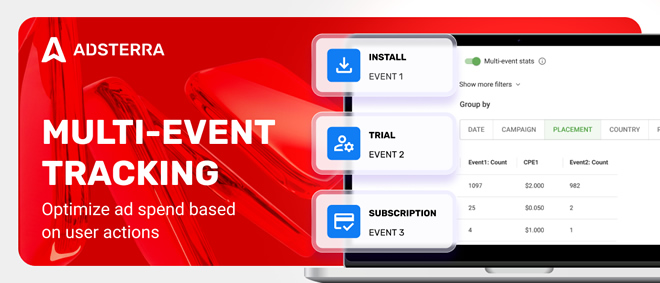
Multi-event tracking addresses this limitation by recording several user actions within the same campaign. Instead of evaluating performance solely by the final outcome, advertisers can analyze engagement across multiple stages of the conversion funnel. This broader perspective helps clarify how traffic sources contribute to both early engagement and final results.
Adsterra recently launched the multi-event tracking feature to provide advertisers with a more detailed view of campaign activity.
Why tracking multiple events
Customer journeys today are complex and rarely linear. A user who clicks on an advertisement may not immediately convert but may still demonstrate interest through intermediate actions such as installing an app or starting a trial.
Monitoring only one conversion event can therefore obscure valuable insights. By capturing multiple interactions, marketers can better identify promising traffic sources, understand where users disengage, and adjust campaigns more effectively. This data supports more accurate attribution and more strategic budget allocation.
Here’s a quick comparison of Single-event vs Multi-event tracking that clearly breaks down the value of the latter.
Where Multi-Event Tracking is useful
Mobile applications and utilities
For app-based products, installs alone do not fully reflect engagement. Tracking both installs and trial activations helps marketers determine which traffic sources bring genuinely interested users. High-performing placements can then be prioritized, while weaker segments may require revised messaging or landing pages.
iGaming and e-commerce
Campaigns in these sectors often pursue more than one objective, for example, installs alongside deposits or subscriptions alongside purchases. Monitoring these events simultaneously can reveal geographic markets that perform differently at each stage, enabling advertisers to adapt offers or bidding strategies accordingly.
Operational benefits
Adopting multi-event tracking can improve several aspects of performance marketing:
More precise ROI analysis, as marketers can see where users leave the funnel
Better budget distribution, focusing spend on sources that generate multiple valuable actions
Earlier creative insights, allowing faster identification of ads that drive deeper engagement
Improved funnel evaluation, highlighting promising traffic segments before final conversion
Greater transparency in reporting, supporting clearer collaboration between advertisers and platforms
Implementation overview
To enable multi-event tracking with Adsterra, advertisers typically configure several technical components during campaign setup. These include activating server-to-server (S2S) postbacks, mapping ClickID parameters, and creating separate postback URLs for each event. Before launching a campaign, marketers should also confirm that events are firing correctly and that reporting dashboards display each action individually.
For clearer guidance, check out Adsterra’s guide on setting up multi-event tracking. It contains a step-by-step set up process with screenshots helping to navigate the feature smoothly.
Full-funnel analytics at hand
As digital advertising becomes more data-driven, understanding user behavior across the entire journey is increasingly important. Multi-event tracking represents a move toward comprehensive campaign analytics, where performance is evaluated through a sequence of engagement signals rather than a single conversion metric.
For advertisers seeking clearer insight into campaign effectiveness, trying out Adsterra’s newest release is the next step in driving more informed decisions without unnecessary gamble.



.png)




































.png)