















Alex Riddick, CEO and founder of PIN-UP Partners and Riddick’s Partners, spoke at the AIBC Eurasia conference, offering an extensive retrospective and visionary outlook on the entire affiliate market. How did the industry evolve from local “exchange platforms” to complex predictive models? Why does in-house platform development sometimes end in failure? And how can you create a partner network that is here to stay?
How It All Began: From 3 Million Users to Peak Performance
Why do I often highlight the period between 2014 and 2026? Because it was during this time that traffic networks became what they are today in terms of their format and mechanics. The groundwork, however, was laid much earlier. And no, I’m not talking about Commission Junction (CJ), as many people tend to think.
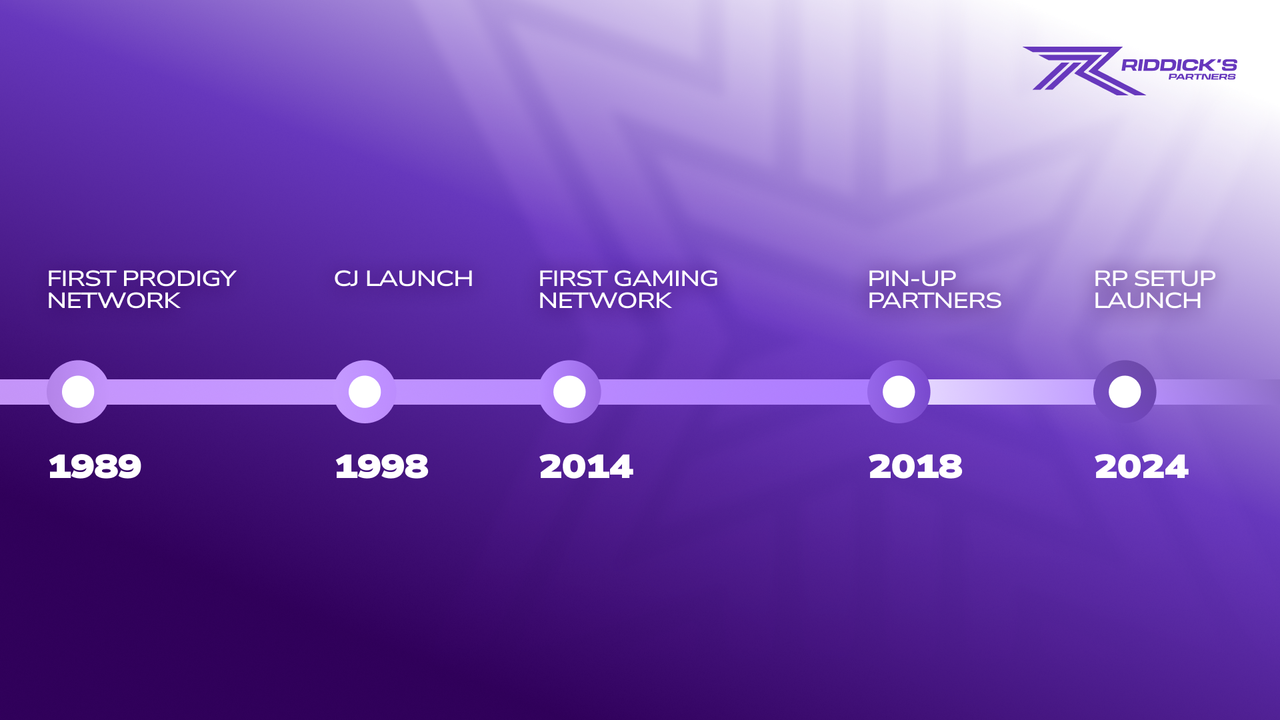
It all began back in 1989. The global Internet user base was barely 3 million. That’s when the first Prodigy came out, a networked service which was more akin to an early version of a file-sharing site in terms of its format — at that time, local networks were just beginning to transform into the World Wide Web. But it was 1998, widely considered the official birth year of affiliate marketing, that saw the launch of CJ Affiliate in the US, which worked primarily with e-commerce.
Each stage of this evolution (up until 2014) meant changes in everything: formats, offers, topics, traffic sources. The affiliates who developed this market have always been known for their adaptability.
From 2008 to 2014, there was a real boom in multi-vertical CPA networks. Admitad, Ad1, CT Ads — these guys essentially created demand for affiliate traffic and Internet traffic in general. Before that, all marketing was done offline; it was classic promotional campaigns. The bulk of the online advertisement was websites and media campaigns where top foreign advertisers simply poured huge amounts of money into bots. Ultimately, the market quickly shifted to lead generation, and direct advertisers finally learned what true performance marketing is.
The Golden Age of iGaming (2014–2018): Half a Million Leads and the Mask Comes Off
The year was 2014. By that point, I had already been actively dealing with traffic for two years, uploading various gaming offers. That’s when it hit me: the offers out there pay three times less than the actual KPI that managers on the product side are working toward.
We met, talked, and went straight to the point: “What if we build a network tailored to your needs, take our 30% commission, and sell this traffic to you?” The answer was: “Let’s do it.”
Keep in mind that this was a completely new format at the time. Although this type of offers was technically available in the networks, they did not receive targeted traffic. The networks lacked the ability to work with specific sources, did not understand gaming constraints and approaches, and were, frankly speaking, completely unsuitable for the task. We agreed, got started — and things took off in a big way.
Along with our first offer, Vulkan, other big players started popping up on the market, such as Vegas, Joy, and sports brands. Fast forward to 2016 — the peak of this movement. Summer, European Football Championship. In that month alone, we managed to attract around half a million paying leads for sports offers. We saw that it worked really well.
Then we shifted our focus to sports and actively engaged webmasters. ASO was at the top of the traffic sources, and Google had not yet learned to recognize arbitrage cases and block them en masse.
But that was when a change happened that would forever alter the ad network market. Direct advertisers asked themselves a logical question:
“Why work through middlemen and earn less when we can work directly with websites and earn more?”
Until that moment, all product representatives were anonymous and never participated in conference calls. The work was done only via Skype. And they were all called Alex, and all their bosses were called Kostia. It was the absolute market standard.
In contrast, we would go to all the conferences and meet webmasters face to face — the market was becoming transparent. That’s when we started thinking about our own product. We set about creating the product software and our first affiliate program.
We slowly made it to 2018. Our own offer came out. A few more strong direct products have appeared on the market, and classic networks have essentially become redundant.
Then I just cut the commission rates for the networks. Why? Because their value was gone. They did not bring in new unique traffic; we already knew all of the key partners directly. Just like any other product marketer, we didn’t want to overpay 20–30% extra.
Ad networks began frantically searching for ways out: some developed their own products, some shifted into their own media buying, and some moved into SEO. Classic-style networks stayed around only for niche cases: to get some kind of high-end offer that you couldn’t get directly, to score an exclusive deal, or just to quietly make some extra cash on your private network.
Since then, and up until 2024, the ad network market has remained virtually unchanged. Today, you can count on one hand the number of networks that have a solid base of webmasters, an impeccable reputation, and strong in-house arbitration and SEO teams.
The Birth of a B2B Ecosystem: 2024 Transformation
In 2024, we made a strategic decision to move into B2B. At that point, we had a clear vision to transform the ecosystem we had been building for years into a full-fledged business group. A group that both works with its own in-house products and acts as a B2B provider: platform solutions, anti-fraud, marketing, payment solutions.
We needed a network that would deliver strong results with external offers.
Since I have been in the traffic business since 2008 and have seen all the ins and outs of this business, I knew for sure that we would not be able to launch it in the usual format. It would either be another project that generates no profit and only consumes a significant amount of time, or we would simply become another run-of-the-mill traffic arbitrage team.
We decided to approach this task the same way we had approached all our previous products. We’ve never done exactly what our competitors do. We took a business idea, broke it down into tiny pieces, and put together a unique setup that would definitely take off in the market.
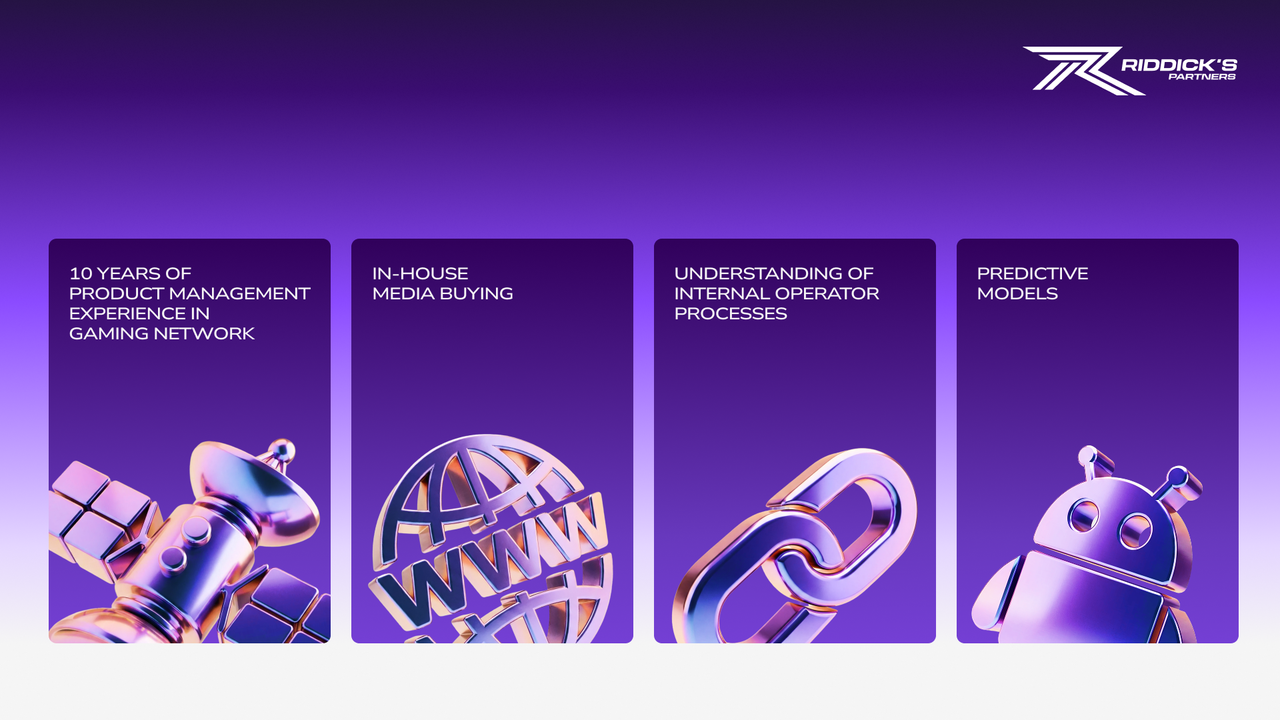
As we explored the concept of the future network (which later became Riddick’s Partners), we identified the key streams that are essential for survival in today’s competitive environment:
Full-cycle expertise
Our main unique selling point is that we provide turnkey performance solutions for advertisers. We have extensive expertise across all sources. When we look at a product, we can clearly identify which metrics and parameters need to be monitored to ensure that traffic pays off and generates profit, rather than becoming a dead weight.
Product Background and Predictive Models
We’ve been at the top of the gaming industry for 10 years. This makes it easier for our BizDev managers to sell and attract the best direct advertisers. We understand how a product enters new GEOs, how processes break down and are built up, and how a campaign’s speed slows down when scaling.
My personal pride and joy is predictive models. Predictions are something that a small in-house team is simply incapable of doing physically. It requires a huge historical database and an understanding of the triggers and behavior patterns that influence a customer’s final ARPU. Since 2022, we have been actively using a predictive model, which we are currently implementing for a number of offers at Riddick’s Partners.
Another story that is rarely discussed in public is the evaluation of media campaigns based on post-view data. These are models that consider not only direct acquisition, but also reactivation, ARPU change, and brand interest growth, laying it all out in graphs. You can clearly see whether it is profitable for you to use it.
A Team Where Our Middle Affiliates Are at Team Leads in Other Companies
We have an incredibly strong team. Take, say, our affiliate managers. The average middle affiliate at our company has more expertise than a senior or team lead at most other companies. Why? Because they’ve grown with our product, our internal training programs, and our tools.
They don’t just pass on links. They make it a win-win. There are cases where a major advertiser with a million-dollar budget comes and says, “Get me traffic.” We spend a test $5,000, stop, and say, “Dude, go fix that offer. Else you’re going to lose all your money right now.”
Growing Pains: Your Own “Cosmolot” vs. Ready-Made SaaS
This is probably the most relatable part of this story. How we wrote the software.
At first, we figured, “We’ve got this awesome ‘cosmolot’ — our in-house platform.” A bunch of tools, everything in real time, complete transparency, product integration, seamless transfer of huge arrays of data, great backups. “Let’s build a network using our in-house software!”
So we went for it. We assembled a team and gave them three months. They rolled out an MVP. We tested it, approached advertisers who were already lined up for integration, and realized... we couldn’t integrate it.
We have too many parameters, and advertisers are using third-party B2B platforms that are technically incapable of processing this amount of data in real time. To iron out this synchronization, we have been given a timeframe of one and a half to two years based on the developers’ current roadmap.
The idea was scrapped. We decided, “We’ll just code our own network from scratch.”
The team was reassembled and given six months. Wrote the code. It was a complete failure. Tons of testing, endless bugs. We tried to fix it, only to realize that it would take at least another year. Meanwhile, competitors in the market are working hard.
Ultimately, we swallowed our pride and decided to go SaaS (renting third-party software).
We researched all the top platforms available in the market. We asked our friends to give us access to admin dashboards and compiled feedback from arbitrage teams on what they found most convenient to work with.
We came up with a strict checklist of requirements:
Rapid launch (we already lost a year on development, and customers were leaving due to our “crutches”):
Platform security. Leaking databases to the public poses enormous reputational risks that we cannot afford to take.
Scalability. The system must be designed to support 1000+ active partners (more than 100 websites per manager) without any slowdowns.
Financial flexibility. Capability to set flat fees, spend-based payments, additional commissions, baselines, and flexibly juggle CPA models within a single account for different sources.
In-depth analytics. Right down to the individual client and their activity.
Four products made it to the final stage: AlarmBase, Affise, Scaleo, and Affilka. All of them are suitable for a basic gaming network. Still, when you’re working with an exclusive product, the devil is in the details.
For one, tech support. We needed 24/7 support so that any critical situation could be resolved within an hour, with the entire technical team on call. Flexible statistics on cohorts and sources were key. Our chosen crew at Affilka accommodated us: we requested they add a couple of domains in the format we needed and adjust a couple of metrics — they did it in a week as the basic setup was in progress.
Sure, there were downsides — SaaS solutions are reluctant to work with crypto payments because of the risk of payment modules getting hacked, but it was worth it.
Reputation As Your Most Important Asset
Last but not least, reputation is crucial.
When you work with exclusive offers, you gain access to in-depth in-house product information. Partners and advertisers must be 100% certain that their data will not be leaked, their product metrics will not be given to competitors, and the expertise shared with them is genuine.
The market is currently flooded with pseudo-experts promising to deliver a “turnkey product”. Nine out of ten projects like this will never get off the ground. A successful business is a complex combination of factors that must be managed based on real experience rather than flashy presentations.
Everything we do, we always do differently. We approach business from the perspective of key metrics that affect money, and we build processes so that they are more tech-savvy, cheaper to implement, or simply better than the rest of the market.
Here’s my top tip for setting up any business: don’t just look at how successful competitors do things and try to copy them. Think about how to make your specific business better at solving the problem. After all, copies will always be overshadowed by the original.





.png)













.png)