















Entering the Tier-1 market is one of the most difficult tasks in SEO affiliate marketing. That is why real cases are so valuable, they show that it is possible to enter Tier-1 GEOs and make a profit.
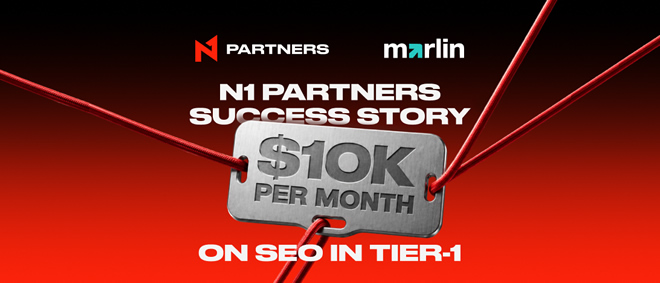
In a new series of success stories, the N1 Partners team reveals a case study on SEO traffic — read how the team was able to reach $10k and 800 FTD per month without experience in selected GEOs! You will also learn how to build a Tier-1 growth strategy from scratch, start working with drop domains, and scale the result as efficiently as possible.
No theory, just practice, numbers, and specific hacks that worked.
Goals and Intro
Partner — Marlin Traffic, SEO team at iGaming that works with monobrand sites and organic traffic.
Main traffic type: SEO (mono-brands, slots, small-page sites).
GEO focus: Tier-1 (European countries and Australia).
Main challenge: entering a highly competitive Tier-1 market from scratch and scaling the results by competing with established teams.
N1 Partners brands to drive traffic: Slot Mafia, Slot Lounge, RollXO, HollyWin.
Partner Info
Name: Marlin Traffic
Affiliate experience: 1.5 years
Background: The team consists of 4 founders from digital agencies who previously worked with client projects (SEO, Google Ads, paid social, etc.). From the start, they assembled a core team (SEO, development, content and paid traffic specialists) and launched their own projects.
Specialisation: SEO in iGaming, mono-brand websites, slot pages and cluster nets.
Issues encountered at the launch phase
Despite the experience of working with SEO traffic, the team faced a number of difficulties when entering the Tier-1 market.
1. Starting without experience in the niche
The first projects were launched in Tier-3 GEO (LATAM) but did not generate significant revenue, and traffic monetisation turned out to be low.
2. Transition to Tier-1
This is a market with great opportunities:
competition with large SEO teams
competitor domains with strong trust
high entry cost (content + links)
3. Finding a working model
At the start, review sites were used, but they did not provide the necessary positions, and monobrands dominated the SERP.
4. Scaling
After reaching the first profit, it was necessary to scale the bundles and maintain the effectiveness of the team at the growth stage.
Growth strategy
For further scaling, together with the N1 Partners team, a strategy consisting of several key elements was built.
Transition to a single-brand model.
After analysing the SERPs, the team moved away from classic review sites and shifted focus to single-brand projects and low-page websites.
Result — the first stable profit (~$10k/month) is already in Tier 1.
Scaling via clusters.
Within one cluster, they launched 2 to 6 sites (sometimes up to 10), testing different approaches within the same search intent.
Result — faster ranking velocity and reduced risk of a “dead site”.
Working with drop domains (key angle).
The core lever became drop domains.
Instead of relying solely on fresh domains, the team активно использовала expired domains with history, backlink profiles, and relevant topical authority.
This allowed them to:
significantly speed up indexing
achieve faster ranking growth
reduce time-to-result
If fresh domains were taking 4-6 months to show results, drops were delivering them within 1–3 months.
How does the drop-domain model work? Strategy breakdown
Using drop domains (expired domains) is a way to accelerate branded SEO in iGaming. The main goal is to test and push branded clusters into top rankings faster while reducing risk and waiting time.
Problems with classic branded SEO:
cluster validation takes 6+ months
only ~1% of sites become profitable
hard to lock in top-3 positions
risk of domain loss
What drop domains allow:
fast hypothesis testing
leveraging existing backlink profiles
accelerated rankings
Used when:
search volume > 2000
demand trend is growing
Drop-domain workflow (3 stages)
How to properly build a drop-domain pipeline and get results? Three steps below.
1. Drop hunting & filtering
The goal is to find domains with strong backlink authority.
Process:
collect domains from .gov, .edu, news sites, and traffic-driven resources
analyze via Ahrefs (DR, dofollow backlinks)
clean up spam and toxic links
check history via Web Archive
Result — out of ~25,000 domains, ~50 high-quality assets remain.
2. Relaunch & testing
each drop = standalone site
unique design and content
testing multiple SEO approaches
Backlinks:
built based on competitor profiles
aggressive experiments are allowed
Results:
18–20 out of 50 get rankings within ~4 weeks
21–25 domains move forward
3. Trust transfer (merging into EMD)
The goal is to boost the main money site (EMD).
Methods:
Canonical → ~40% success rate
Hreflang → additional ~10%
301 redirect → additional ~10%
If it doesn’t work: domains are reused in PBNs or as content sites.
Strategy results
If you follow all the stages, you’ll get the following results:
increase in “money sites”: from 1% to 3%
~40% hit top-3 in <3 months
+20% reach top within 4–6 months
Key insights on working with drop-domains
The team’s experience shows that drop domains are not just a link-building tool, as often perceived in the market. Primarily, they are a way to drastically accelerate SEO hypothesis testing.
General insights:
Drops are a testing acceleration tool, not just link building;
Scaling (dozens of sites) is critical;
Most drops are expendable assets;
Core value = passing link equity to EMD.
In combination with classic SEO:
content tailored to specific intents;
link building using diversified link types;
scaling via site networks and cluster approach.
Operational efficiency:
strong core-team (SEO, development, content, paid)
well-established launch and scaling processes
Results:
fast rollout of new sites
parallel execution across dozens of SEO clusters
Case results
In approximately 1 year operating under this model, the team achieved:
growth from 0 → $10k/month (early stage)
further scaling after entering Tier-1
Current metrics:
~100+ SEO clusters in progress
800+ deposits per month (FTD)
dozens of active sites (within cluster model)
Additionally, they significantly accelerated ranking timelines and built a stable SEO traffic flow.
Case conclusion
Successful collaboration with Marlin Traffic became possible due to the combination of two key factors: a strong N1 Partners product and well-structured partner operational work.
On the product side, the decisive factors were high conversion rates, solid retention, and transparent terms. This is confirmed not only by subjective evaluation but also by real tests: in target GEOs, N1 Partners consistently ranks top 1–2 in performance, which is crucial when dealing with large traffic volumes and monetisation.
The team was equally critical. The interaction is systematic: continuous communication, transparency in metrics, support in analytics, and a proactive approach not only maintain current performance but constantly unlock new growth opportunities. This reduces operational load and accelerates scaling.
A key feature of working with Marlin Traffic is the two-sided collaboration model: for every launch, both sides test hypotheses, optimize funnels, and converge on the most efficient setup. This approach turns almost every campaign launch into a successful case.
Ultimately, the combination of a strong product and a highly engaged, performance-driven team creates sustainable growth and lays the foundation for further scaling.
Work with N1 Partners — scale your campaigns on SEO traffic with maximum efficiency!
14+ casino and betting brands with high Reg2Dep
10+ Tier-1 GEOs
CPA up to €700 and RevShare up to 55% + NNCO for top affiliates
Be number one with N1!







.png)


























.png)