














In 2026, classic dating offers are getting harder to profit from. The swipe-to-match approach has stayed the same for years, and it shows. When buyers keep using the same “singles near you” angle, click-through rates drop as markets get saturated, even if payouts stay the same.
AI dating is the first big change in this space in a long time. The offer now features an AI companion, such as a matching algorithm or a chatbot that remembers past conversations.
For users, it's a new product; for buyers – a fresh angle. We all know that new approaches work better because people aren't tired of them yet.
Why AI Dating offers convert differently
The most obvious reason this is outperforming classic dating is novelty. People aren't tired of this format yet because it hasn't been overused on every push and across native networks, unlike the hot singles angle.
Another reason is what happens after someone clicks. AI matching gives users something to do, like taking a quiz or using a “build your match” screen, instead of just viewing a list of profiles. This extra step reduces early drop-offs. Once users start chatting with the AI, they stay longer than if they were just swiping. More time in the app usually leads to better chances of getting a deposit or subscription.
There's also a difference in payouts. As AI dating advertisers are new to the market, they often offer higher payouts to attract affiliates and traffic. For buyers, that creates stronger monetization potential than classic dating offers, especially when engagement stays high after the click.
Setup
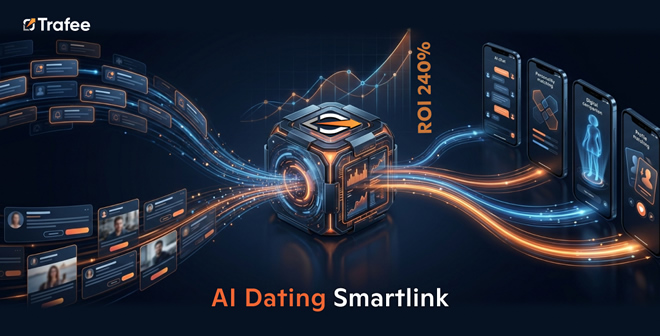
Trafee's dating Smartlink now includes AI dating offers in its rotation, with auto-optimization handling offer matching in real time. Using this setup across Push and Native formats on a CPA via Trafee Smartlink buying model, one affiliate ran an 8-week test targeting Brazil, the Philippines, and India, turning a $4,800 total budget into $16,320 in revenue — a 240% ROI, with potential to grow further.
In this case, the choice of GEO was more important than the creative. Brazil, the Philippines, and India were chosen because there weren't many AI dating offers in those markets yet, so the cost per click was still low. That price gap is where the profit came from.
The creative was kept simple by focusing solely on the AI angle rather than calling it a dating app, resulting in a much higher click-through rate than standard dating ads in earlier tests.
The budget started at $400 per week, enough to get clear data for each GEO without wasting money on segments that didn't convert.
Two main tactics then made the biggest difference: frequency capping, since push audiences in these markets tire of repeated ads quickly, and dayparting to focus on local evening hours when conversion rates were 30-40% higher than during the day for the same spend.
Results
By week eight, weekly spend had gradually scaled from $400 to $800 based on performance, while maintaining an overall ROI of 240% across the eight-week test. The Philippines carried the campaign, while Smartlink's auto-routing helped maximize revenue by matching each click to the AI dating offer that was converting best at the time.
What went wrong
As in classic dating, things didn't go smoothly from the start. The first creative used a generic “chat with AI” headline that didn't highlight the product's strengths. CTR on push was average, and the campaign was close to breaking even by day 10, which wasn't encouraging for a new smartlink.
The real improvement came from being specific: naming the exact AI feature, like instant matching or personality-based pairing, and using a real screenshot of the in-app chat instead of a stock photo. CTR improved once the creative started showing the product instead of just describing it.
The second mistake was even bigger. The campaign started with a total budget of $400 per week, split evenly across all three GEOs to gather data before making changes. But the Philippines was already performing better in the first week, and the budget split did not change until day 12. That meant the campaign spent nearly two weeks with an even budget split.
What this case shows
Smartlinks can make offer testing more efficient. With a fixed offer link, you have to find the best offer by testing each one yourself. The smartlink's auto-routing found the top-converting AI dating offer for each GEO faster than manual testing and kept adjusting as offers changed.
The AI angle is working now because it's still new. As more buyers start using it and similar ads appear across networks, the click-through-rate advantage will shrink, just as it did with classic dating offers.
Tier 2 GEOs still offer opportunities. Brazil, the Philippines, and India had fewer AI dating offers than Tier 1 markets, which meant lower costs per click and higher margins even before optimization.
You can test this model with a small budget. The entire approach was proven with less than $5,000. There's no need to spend a lot before you know if the offer, GEO, and creative combination work.
How to replicate this with Trafee
Sign up at Trafee
Start with a smartlink rather than a single offer, and let auto-optimization handle the first round of matching.
Choose two or three Tier 2 GEOs where there aren't many AI dating offers yet, instead of automatically picking Tier 1 markets.
Make sure your creative highlights the real AI feature and uses an actual screenshot.
Launch with a conservative budget across all GEOs, as well as set up frequency capping and dayparting early
If you're already running push, native, or pop traffic and haven't tried AI dating yet, Trafee's smartlink is the quickest way to see if you can get similar margins.
Start testing AI dating offers on Trafee today.






.png)